

Why Doesn't Anyone Use Their Citi Bike Basket?
Investigating a basket case.

Leg Day is a newsletter about the pursuit of joy as a city cyclist.
I was walking my dog on a recent Sunday morning when I saw three people heading up Classon Ave in Prospect Heights on gray electric Citi Bikes. There’s nothing all that odd about this. The service is mega popular, reporting in July 2025 that it was used on average 164,364 times per day1. Despite a newly instituted 15 mph speed limit, the electric Citi Bike remains one of the fastest and most efficient ways to get yourself around Central Brooklyn, where there are few train lines that take you north or south. I often find myself unlocking one when I’m in need of a bike with a basket to carry something bulky, like the rack I now use to store my road bikes.
So you can imagine my surprise when I noticed that each of the people who passed me in a line last weekend was carrying their flaccid totes on their shoulders. Each of these shoulder bags, which appeared basically empty, seemed tailor made to be stored in the rectangular basket of an electric Citi Bike.
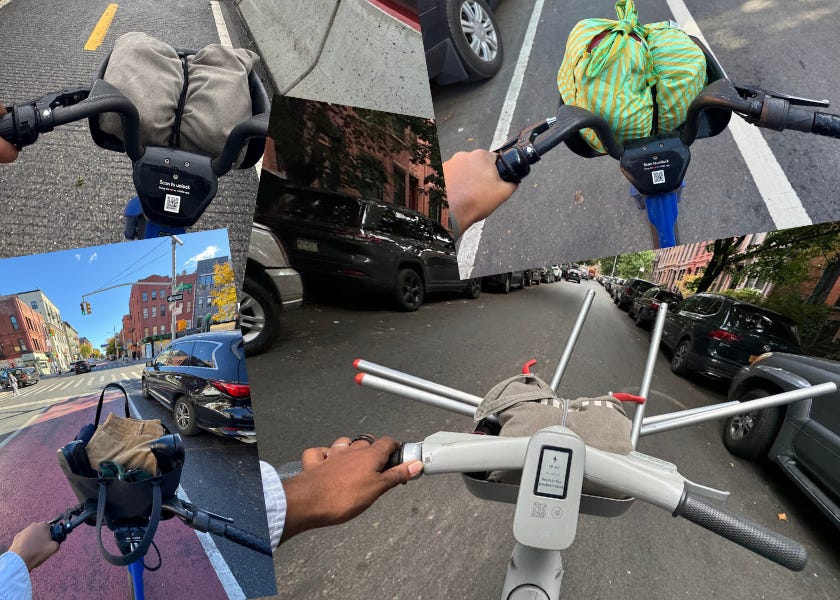
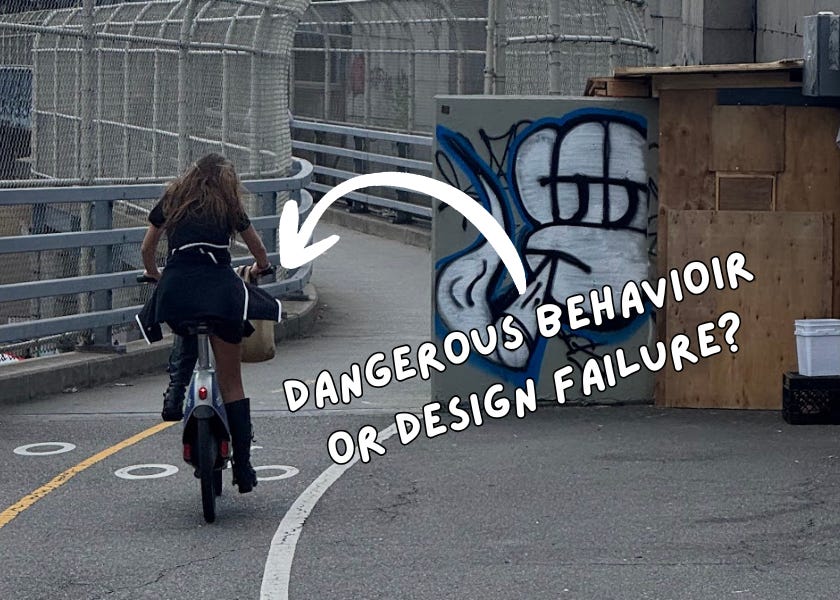
I’ve started to notice this confounding carry choice all over the place. On the approach to the Manhattan Bridge last month, I saw a person balancing a super stuffed tote on their bike’s front handlebars. I see people riding these electric bikes one handed constantly, often using their other hand to hold a water bottle. And during a recent video my coach posted from a Central Park ride, he pointed out someone on a Citi Bike who was absolutely cranking it to get up the hill while their backpack swung from side to side. I couldn’t help but wonder, why was it on their back in the first place?
I replied to Max’s video with this simple question and quickly got two replies: “urine” and “piss.” Before writing these folks off as fragile suburbanites, I decided to see if there was any merit to their claim. I found no scientific or city-sponsored studies about whether Citi Bike baskets had been peed on. The closest thing I read is a piece from 2017 where then Men’s Health editor-in chief Matt Bean took a handheld germ counter around New York City to swab a bunch of commonly touched surfaces to see what was the least hygienic2. A Citi Bike handlebar ranked germier than anything else he tested—grosser than a door knob in Grand Central station, a hold bar for the Subway, and one of those LinkNYC kiosks that are always pushing fun facts and odd truths.
The leap from the finding that “Citi Bike handlebars are dirty” to “Citi Bikes are covered in piss” seems like a big one. But handwringing about the cleanliness of shared public infrastructure is a deeply American tradition—if you can’t convince people the subways are gross and dangerous, how are you going to sell them cars?
Maybe I’m just naturally more nonplussed by the thought of urine on surfaces than some other people. After all, urine is sterile.
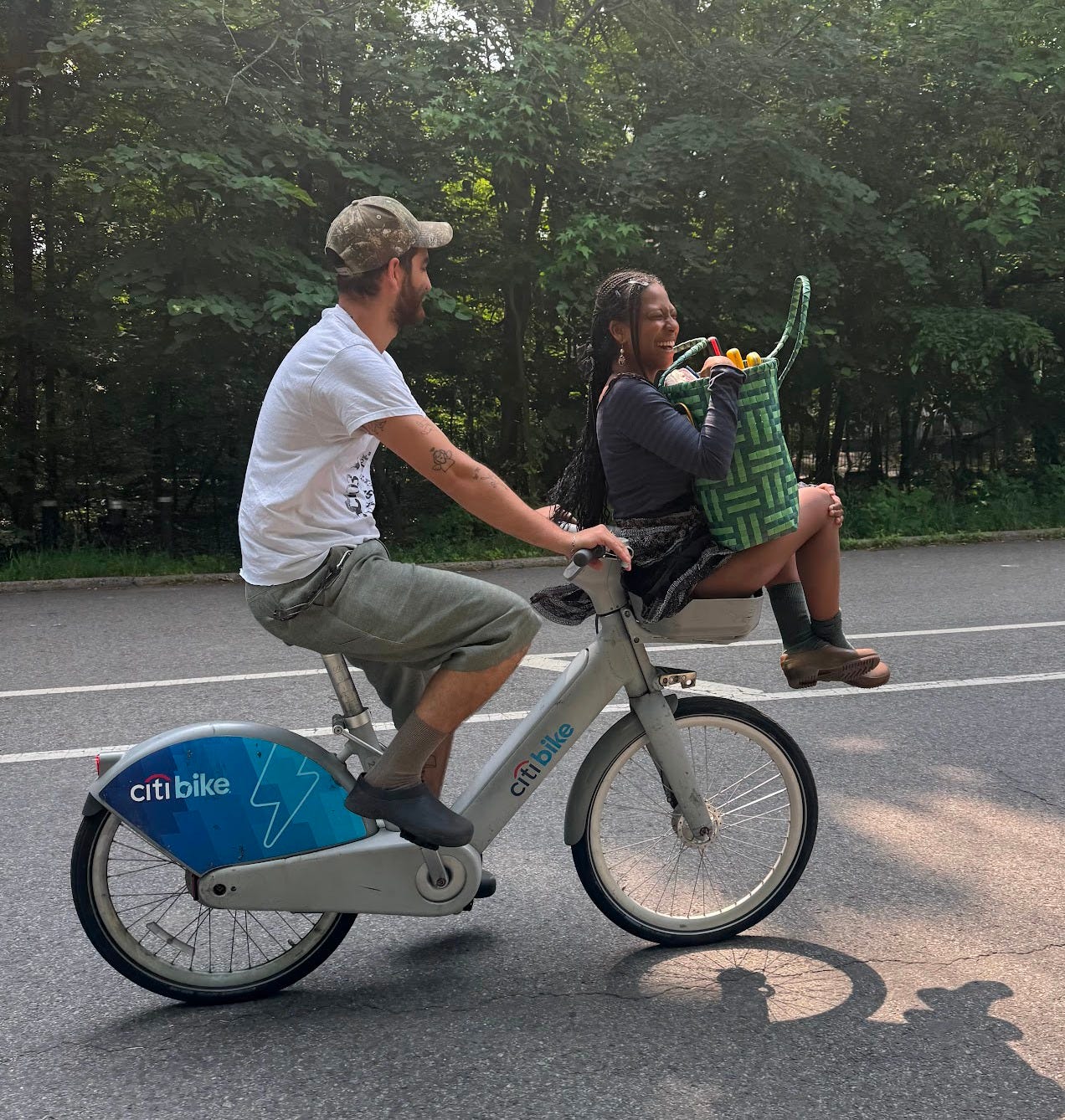
I put a call out on my Instagram account to see if any devoted Citi Bike riders had more logical justifications for why one would choose to bike with a tote on their shoulder. Someone told me they kept their bag on their shoulder in case of a robbery. I could find no reported cases of someone getting mugged while riding a Citi Bike (though I found lost of stories about people using a Citi Bike as their getaway vehicle à la Luigi) but this is also just something I don’t personally worry about. Anyway, if someone was trying to snatch your bag, wouldn’t it being on your shoulder allow them to pull you to the ground? In that case, you wouldn’t just lose your stuff, you might also get pinned under the weight of your bike.
That said, by far the most common reason people told me they didn’t use Citi Bike baskets was that they had no confidence anything they put in the basket would actually stay in the basket. The shallow baskets are often super loosely attached to the bike frames, and bounce around even when you’re riding over smooth pavement. On both electric and acoustic Citi Bikes, these baskets have an elastic strap attached that should allow you to tie down whatever is inside. I’ve found this strap works well for keeping a backpack or tied off bag of groceries secure, but it’s certainly of little use if you’re carrying a slim tote or tiny clutch—the strap can only hold down what’s bulbous enough to extend over the basket walls. Riders told me they had seen water bottles, laptops, and phones eject themselves out of baskets too many times to trust them.
Though this has never happened to me, I can certainly see why one would react to this fear by choosing to carry their tote or clutch on their shoulders. I’m still dubious the strap wouldn’t work well enough to tie down a backpack, as long as that strap isn’t missing or broken, so that you can arrive to your destination free of back sweat. (If you’re worried about a water bottle flying out of the side pocket of your backpack, just toss it in a zipper pocket during your ride.)
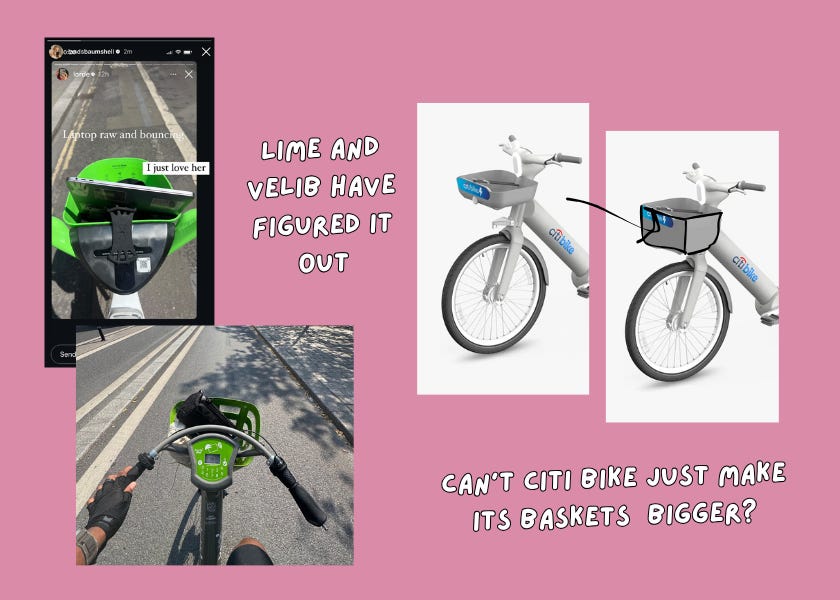
I’m starting to understand basket misgivings as a reasonable reaction to a failure of how these bikes are designed. If the basket was taller, for example, things might be less likely to bounce out.
In fact, I’ve already experienced a better bike basket. In Paris, I used Velib, a bike share service that pre-dates Citi Bike by a half decade. Velib bikes have much deeper baskets than Citi Bikes, which gave me plenty of confidence all the loose bags and totes I stored in them would stay inside even if I ran over a bump. Some of these bikes even had a little pouch attached to their handlebars that served as a phone mount.
More compelling, the baskets on Lime bikes (which you’ll see in a lot of other U.S. and European cities) are big enough to accommodate a laptop on its side. Just ask Lorde, who posted a picture of what appears to be an unsleeved 13-inch Macbook “raw and bouncing” in the basket of one to Instagram last summer.
Even if I can understand the logic behind the choice, I still wince whenever I see someone riding with a tote on their shoulder or handlebars. I’ve always found its harder to keep myself balanced if I have a tote adding weight to one side of my bike, but also worry about the bag getting caught up in the spokes of my wheels. Some Citi bikes have super large fenders and wheel covers that makes the latter of this issue irrelevant, but the electric Citi Bikes don’t. If you find yourself on one of these, be super careful about making turns. Death by Trader Joe’s tote would be a terrible way to go.
ONE LAST THING … Last week, USA Cycling just announced it was caving to pressure from the Trump administration and that Trans women can no longer participate in women’s fields at any USA cycling events. The Century Road Club Association, New York City’s primary race organizer who require racers to have a USAC license, has called the change “disappointing” and expressed confusion about what it should do moving forward.
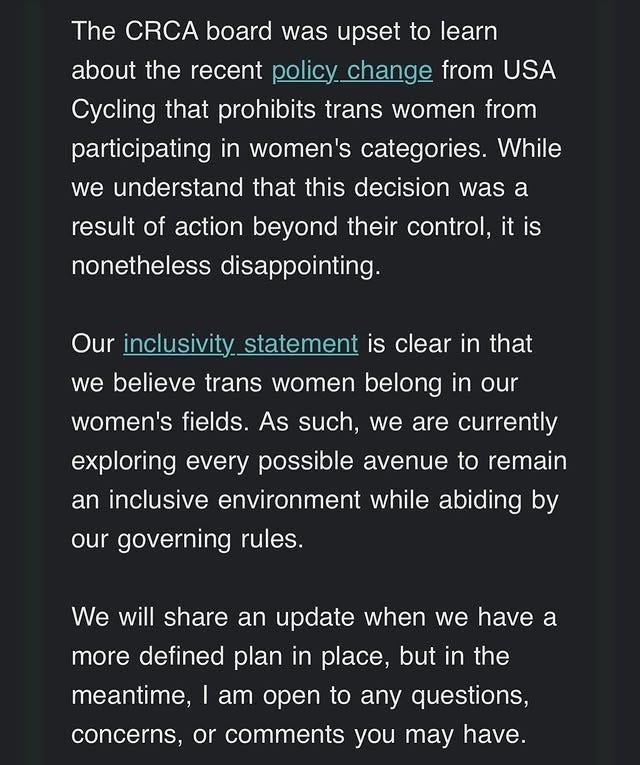
I suppose they’re nominally on the right side of history, but the statement feels a bit limp to me. Especially because plenty of local cycling organizations, teams, and riders have been much harsher with their words. “Yesterday, USA Cycling chose to align itself with discrimination and exclusion,” said the organizers of Kissena Velodrome on Instagram, who run events for racers with and without USAC licenses. “We want to stand firm with running inclusive racing fields even if it costs us USAC affiliation,” said W.0 Racing, a local team that participate in the CRCA races. “If USAC says that some of our friends are not welcome here, then USAC is not welcome in the NYC women’s peloton,” said Continental Ostroy. (Many others, including Be Cyclocross, Angels NYC CC, and All.Ways Cycling Club have also weighed in.)
Honestly, I’m too new to cycling in New York to fully understand the context for the conflict and all the various stakeholders. But I know how insincere the claims are that these bans protect women in sports. As I discussed when I profiled Bad Pony Racing, the architects of these bans have made it very clear that all they actually want is to eliminate trans people from public life. We won’t have it. If you’re a CRCA racer, I urge you to contact the CRCA to hold strong in its policy.
Citi bike publishes monthly operating reports to the Department of Transportation about its usage statistics, maintenance issues, and financial health. You can see them all (going back to June of 2013!!) here.
Or, I should say, my friend Kenneth found some justification for the take for me.
My move is to tie my tote handles around the basket strap. If I’m using a backpack, I pull the basket strap through my backpack straps to more effectively keep the bag in place.